I was born and raised Mormon, growing up in Utah, the heart of Mormonism. It was a unique environment, filled with teachings I both valued and struggled with. Among the doctrines I struggled with most was the emphasis on sexual purity. For me, it created a deep sense of suppressed autonomy and low self-esteem. Mormon theology places immense importance on virginity, teaching that sexual relations are proper only between a man and a woman who are “legally and lawfully wedded as husband and wife.” But what was I supposed to do, having been born acutely aware of my own sexuality? Why could I not explore it before marriage without feeling sinful?
At age 12, young Mormons enter the Young Men and Young Women’s program, where discussions of “proper” sexual behavior begin. One lesson that stayed with me was that sexual sin is nearly as serious as murder. OUCH. These messages, combined with a constant fear of violating God’s law, led me to believe I couldn’t trust myself. I accepted, unquestioningly, that men who claimed to speak for God were the only ones who could guide my sexual behavior.
The church does provide a path for forgiveness: confess your “misdeeds” to your bishop, the leader of the local congregation. As a highly conscientious, Type-A teenager, I took this very seriously. Fear, guilt, and shame weighed heavily on me, and I often felt compelled to confess—even when my “sins” were nothing more than natural curiosity.
Halfway through my senior year, I began dating a boy my father introduced to me. Our families were friends, and I vowed that this time I would live up to every expectation of my religion. “This time,” I told myself, “I will do everything right.”
Our first date was New Year’s Eve, 1999. I left that night wanting only to know him better. I had promised myself that our relationship would go no further than kissing. Over the next two months, we grew closer, sharing our first kiss—a brief, electric peck that felt like nothing I had ever experienced. Two months later, we attended his senior prom together. The boys in our group rented a Mercedes limo, and I remember sitting alone with my boyfriend in the back. We kissed again—this time with a little more intimacy—but I honored my limits for three more months.
By July, we had begun having intercourse. I had graduated high school and was living in an apartment with friends. We were in love as only 18-year-olds can be—immature but devoted, careful but still learning. Still, guilt and shame shadowed every moment. We tried to “be good” but repeatedly fell short, torn between desire and the rigid expectations instilled in me.
By November, my fear of Mormon Hell had become unbearable. I set up a meeting with my bishop, hoping to find peace. Instead, he told me I would need to attend a church disciplinary council—a panel of four men who led the congregation. Sitting before them, recounting the most intimate details of my life, was traumatic. I left feeling defeated. Yet, because I believed these men spoke for God, I accepted their judgment.
I was given strict rules for six months: only one public meeting with my boyfriend per week and a single phone call. My world had shattered, and I cried for days. We followed the rules for a while, but by January, we had returned to our previous ways. The council’s damage, however, was lasting. I began to believe I could not trust myself or deserve love, ultimately sabotaging the relationship with my first love and best friend.
The following year, I attended another council for failing to meet the prior stipulations. It took me nearly fifteen years to fully grasp that what I endured was unnecessary, harmful, and deeply damaging to my sexuality. I grieved the loss of formative years free from shame, the loss of my first true love, and the temporary loss of my autonomy. For years, I suffered stress-induced stomach pains, body dysmorphia, and profound self-loathing. How could I not? I had been taught that my self-worth depended on sexual abstinence.
Now, as a mother, the pain I experienced fuels my determination to protect my children—especially my daughter—from similar harm. I want them to grow up with healthy relationships with their own sexuality, free from guilt and shame.

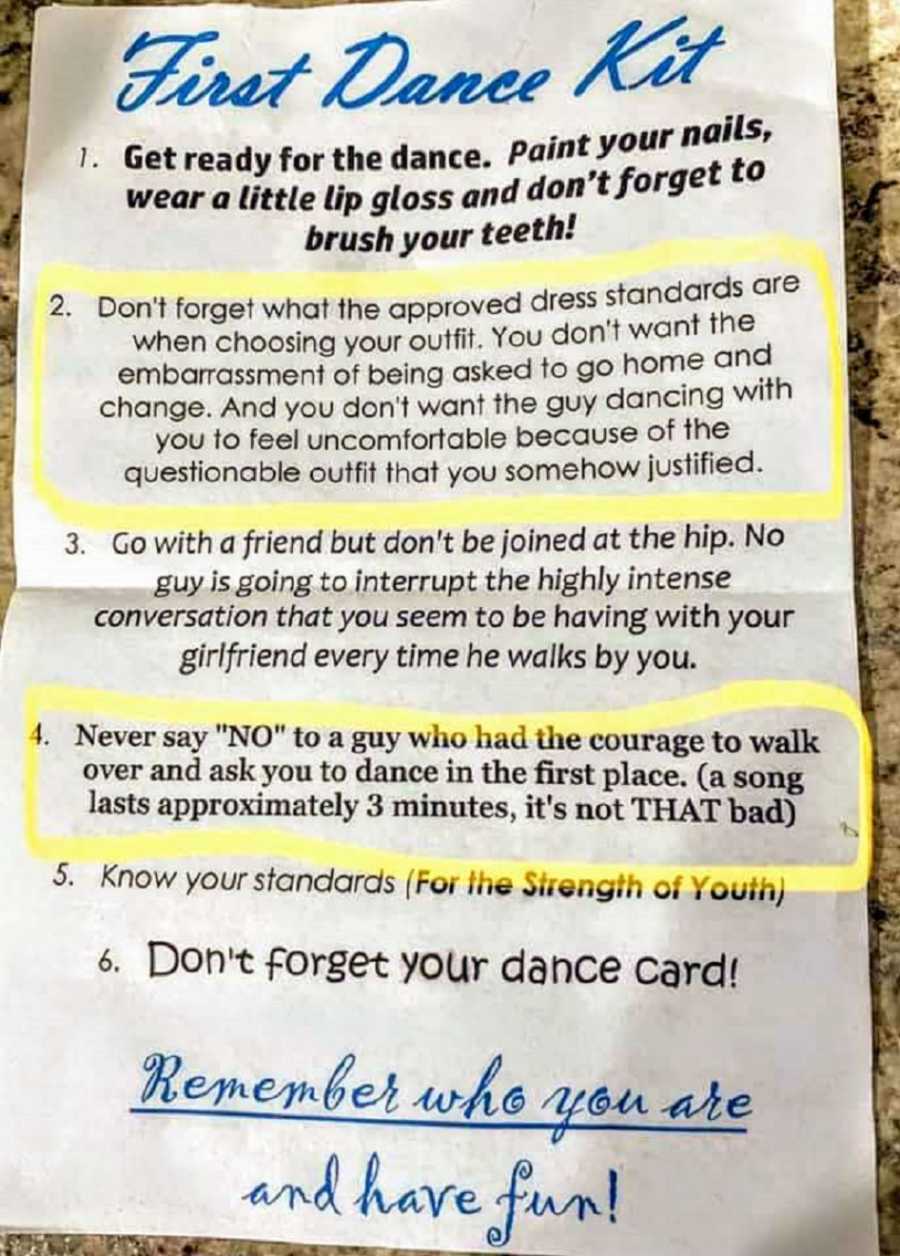
A perfect example of what I fight against is the “First Dance Kit” flyer that recently circulated in a closed Facebook group. It’s the kind of material I never want my daughter to encounter: instructions policing girls’ behavior for boys’ comfort, perpetuating purity culture, victim-blaming, and sexual shame. The idea that girls are responsible for boys’ thoughts is dangerous. Teaching girls to never say “no” to a dance request strips them of autonomy. Empowerment includes boundaries. Respect includes consent.
Healing from all of this has been a journey. Therapy, self-awareness, supportive friends, family, and a loving husband have helped me confront and discard the shame instilled in me. Books like PURE by Linda Kay Klein validated my experience, helping me recognize that the shame was neither deserved nor justified. Each day, I work to replace guilt with self-respect, reclaiming my autonomy and sexuality from the oppressive narratives I once internalized.
I am not unworthy. I am not sinful. I am a naturally curious, fully human woman who deserved to explore her sexuality without fear or shame. And now, I am committed to ensuring my children can do the same.